How do you compose a song worth dying for? That was the question I kept thinking about after the crushing and yet awesome sensory experience of watching Christopher Nolan's The Odyssey. In the Sirens scene (for those who have watched the movie), the music has to make Odysseus's choice to hear the Sirens feel almost reasonable. Ludwig Göransson had to imagine a sound no surviving listener could describe, then decide which voices and instruments might bring us close to it. The intriguing thought for me, a person who works with LLMs and generative AI a lot more than I should, was: where do you even begin with something like that?
I left the theater with that indescribable, flooding feeling that sometimes follows a work of art. People around me often ask how I can use, study, and evaluate AI as much as I do and remain optimistic about our future as a species. Some would even say naively optimistic. For a few hours after the movie, the answer felt obvious. Human beings can make this.
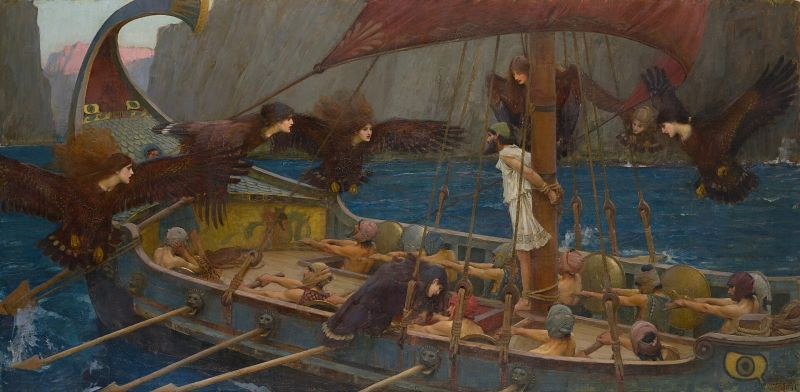
Figure 1. John William Waterhouse, Ulysses and the Sirens (1891). Oil on canvas, National Gallery of Victoria. Waterhouse depicts the Sirens with women's heads and birds' bodies as they crowd Ulysses at the mast.
Collection record: National Gallery of Victoria
I think the scale was only one part of it, and, in essence, this movie itself is only one part of this wider, more general thought of mine (and, I suspect, of many more people). Hundreds of decisions across writing, acting, cinematography, production design, and sound had answered problems that arrived without one correct solution. The result felt like a world I had briefly entered.
So, with that, and as I do, I went and looked at some research. The evidence, though, makes the argument more complicated.
Better stories, poorer libraries
In an interesting 2024 experiment, 293 people wrote short stories either alone or with access to ideas generated by GPT-4 (mind you, this is antique now). Six hundred other participants evaluated the results. Access to AI ideas raised the average novelty of the stories, especially for people who began with lower measured creativity. Yet the AI-assisted stories also became more similar to one another.

Access to AI ideas raised rated story novelty most for writers who began with lower measured creativity. The curves are a study-aligned redraw of the published marginal pattern, not a reanalysis of writer-level data.
A newer study (at least as of the date of this essay) compared 102 people with 22 language models across three standard verbal creativity tasks. Humans and models showed roughly similar individual originality. The model responses, however, occupied a much narrower collective range. A study of more than four million artworks found a related pattern: after adopting text-to-image AI, artists produced more work and received more favorable reactions, while average novelty declined.
So, basically, it appears that AI can raise the quality of one person's creative output while narrowing the range of what everyone creates.
Some would say, especially with how fast generative AI is moving, that these findings are a real argument for AI as a creative tool (though, as you can see, much of the evidence is concentrated in writing). And this could be quite correct at some level. Another study I really like, by Russell and colleagues, was, at the surface level, aimed at comparing narrative patterns in human and AI fiction, but it adds a really interesting point of view. Generally speaking, the variability of AI writing, if put on a graph against that of humans, was a lot narrower, basically more of the same. Also, AI stories over-explain themes and favor tidy, single-track plots, while human stories frame protagonists' choices as more morally ambiguous and have increased temporal complexity. So, AI appears, funnily enough, to trust (or give room to) the reader's creativity and personal experience less, instead explaining and over-explaining almost everything. These results, taken all at once, also tell us something about the tests. A short story, an unusual use for a brick, or an image uploaded to a platform can be rated, compared, and embedded into a numerical space. A three-hour film, a score developed through months of experimentation, or a fictional world built across decades does not fit so neatly.

Across these two StoryScope narrative features, human stories occupied a wider range while stories from five LLMs clustered more tightly. Points are a disclosed sample; contours summarize the full corpus. This is a two-feature view, not a permanent human-machine boundary.
The artifact and the act
AI may eventually produce films, novels, or scores whose complexity rivals the examples I love. I would not build my optimism around a permanent technical limit. But I do see creativity as more than the artifact an audience receives. It is also an act experienced by the person creating it.
A phrase I like, "unprompted creativity," still captures only part of this. At the most basic level, human artists receive prompts too, right? Nolan gave Hans Zimmer a one-page fable about a father leaving his child and asked him to respond musically, without revealing the scale or even the genre of Interstellar. The page did not specify an organ, a melody, or what the closeness and fear of parenthood should sound like. Zimmer still had to decide what the prompt meant. So the "task" here is prompted, but I think that behind it, the silent creative layer is the "reason," which might be life itself.
When I write, something that was previously locked inside my inner life moves outside it. An intuition acquires language, and thus (though not necessarily) another mind can encounter it. Writing, in that sense, extends the self beyond its physical essence. Music and visual art can do the same. The finished work matters, of course, but so does what the making does to its creator.
I think this essay itself is already an example of the idea I'm trying to say above. I first wrote these thoughts quickly, with little organization and even less attention to grammar (and also mind you, English is not my first tongue). The reaction to the movie, the connection to Interstellar, and the idea of creativity as self-extension were mine (as are the ideas still in play, which I cannot even start to put into words). AI can find the papers, challenge the claim, organize the argument, and turn the raw material into an essay. If it offers a connection that changes my thinking, then part of the process becomes genuinely shared (and here, I'm not even discussing the writing itself, which is an art by itself: the style, flow, tone, and wording choices).
That is a part of the reason why I'm still, and hopefully will always be, optimistic about AI, and generally new tech. Many people have thoughts and feelings they struggle to give form. AI can reduce the distance between an inner life and something another person can read, see, or hear. Yet the same systems may translate millions of different lives through similar language and aesthetics.
I am not sure how much of the original roughness should survive that translation. But I suspect more than the model will recommend.
Selected sources
- Doshi AR, Hauser OP. Generative AI enhances individual creativity but reduces the collective diversity of novel content. Science Advances. 2024;10:eadn5290. Open source
- Wenger E, Kenett YN. Large language models are homogeneously creative. PNAS Nexus. 2026;5(3):pgag042. Open source
- Zhou E, Lee D. Generative artificial intelligence, human creativity, and art. PNAS Nexus. 2024;3(3):pgae052. Open source
- Russell J, Rajendhran R, Pham CM, Iyyer M, Wieting J. StoryScope: investigating idiosyncrasies in AI fiction. arXiv preprint. 2026:2604.03136. Open source
- Nolan C. Liner note on the development of the Interstellar score. Interstellar: Original Motion Picture Soundtrack. October 2014. Open source